What Makes a Turning Point
World War II was the largest and most destructive conflict in human history, involving over 100 million military personnel and resulting in an estimated 70-85 million total deaths. Within this vast conflict, certain battles stand out as moments where the momentum shifted decisively from one side to the other. A turning point is not necessarily the bloodiest battle or the most dramatic victory — it is the engagement after which one side could no longer realistically win the war. The National WWII Museum provides excellent context for understanding these pivotal engagements.
The Battle of Britain (1940)
After the fall of France, Britain stood alone against Nazi Germany. The Luftwaffe launched a sustained air campaign to destroy the Royal Air Force and clear the way for an invasion. Despite being outnumbered, British pilots and the radar-based defense system held firm. The failure to achieve air superiority forced Hitler to abandon invasion plans and turn east toward the Soviet Union. The Battle of Britain proved that Germany was not invincible and kept a vital Allied base in Western Europe for the eventual liberation of the continent.
- •The RAF lost 1,547 aircraft while the Luftwaffe lost 1,887 — a rate Germany could not sustain
- •Radar gave British defenders advance warning of incoming attacks, a crucial technological advantage
- •Churchill’s famous speech: "Never in the field of human conflict was so much owed by so many to so few"
- •The Blitz killed over 43,000 British civilians but failed to break British morale
Stalingrad (1942-1943)
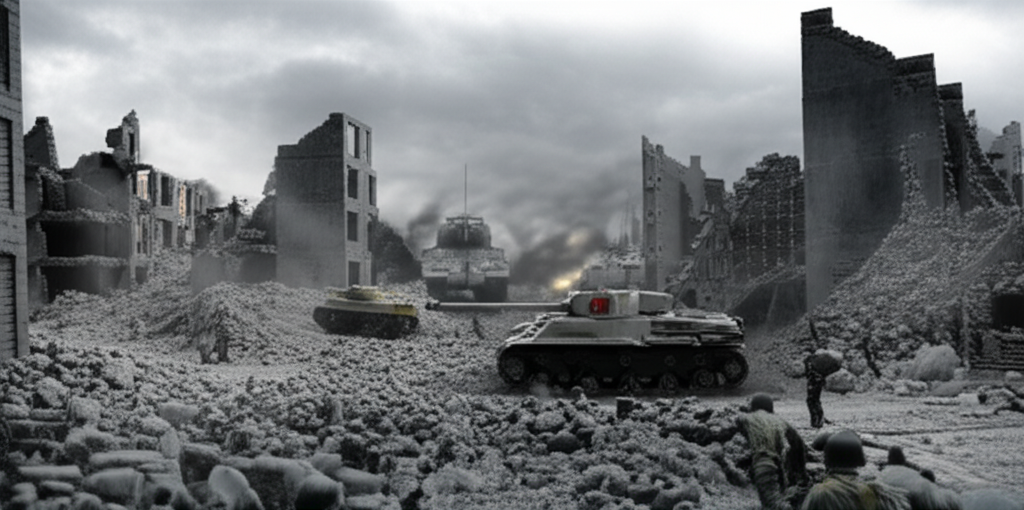
The Battle of Stalingrad was the bloodiest battle in human history, with combined casualties exceeding two million. The Soviet encirclement and destruction of the German 6th Army marked the first time an entire German field army had been defeated and captured. After Stalingrad, Germany was permanently on the defensive on the Eastern Front, and the Soviet Union began the long, grinding advance westward that would end at the Reichstag in Berlin.
What made Stalingrad decisive was not just its scale but its meaning. Hitler committed to holding the city for political and symbolic reasons even after the strategic rationale had evaporated. The Soviet Operation Uranus, launched in November 1942, smashed through the weakly held Romanian and Italian flanks to encircle 300,000 Axis troops in less than a week. Field Marshal Paulus’s surrender in February 1943 — the first German field marshal ever to capitulate — shattered the myth of Wehrmacht invincibility across occupied Europe.
Midway (1942)
Six months after the attack on Pearl Harbor, the U.S. Navy ambushed the Japanese fleet near Midway Atoll and sank four Japanese aircraft carriers in a single day. This engagement shifted naval superiority in the Pacific from Japan to the United States, ending Japanese offensive capability and putting them on the defensive for the remainder of the war. Midway is considered one of the most decisive naval battles in history. American codebreakers who decrypted Japanese communications were instrumental in the victory.
El Alamein (1942)
The Second Battle of El Alamein in October-November 1942 halted Rommel’s Afrika Korps and began the liberation of North Africa. Montgomery’s Eighth Army broke through Axis lines in a grueling 12-day battle that combined infantry attacks, artillery bombardment, and armored warfare. The victory at El Alamein secured the Suez Canal, protected Middle Eastern oil supplies, and set the stage for the Allied invasion of Sicily and Italy. As Churchill famously said: "Before Alamein we never had a victory. After Alamein we never had a defeat."
D-Day and the Liberation of Europe
D-Day on June 6, 1944, was the largest amphibious invasion in history, establishing a second front in Western Europe that Germany could not sustain. Over 156,000 Allied troops landed on five beaches in Normandy, supported by massive naval and air operations. The invasion required years of planning, elaborate deception operations, and enormous logistical coordination. Together with the Soviet advance from the east, D-Day squeezed Nazi Germany from both sides, making Allied victory inevitable.
- •Operation Overlord involved over 5,000 ships and 11,000 aircraft
- •The Allies used an elaborate deception plan (Operation Bodyguard) to convince Germany the invasion would target Calais
- •Omaha Beach saw the heaviest fighting, with over 2,000 American casualties on the first day
- •The artificial Mulberry harbors allowed the Allies to land supplies without capturing a port
The War’s Legacy
These five turning points collectively illustrate how the war’s momentum shifted irreversibly against the Axis powers. Each battle demonstrated different aspects of modern warfare: air power at Britain, urban warfare at Stalingrad, carrier warfare at Midway, combined arms at El Alamein, and amphibious operations at Normandy. Understanding these engagements is essential for anyone studying 20th-century history.
The Turning Points History Often Overlooks
The famous five are not the only engagements that shifted WWII. Several lesser-known campaigns mattered just as much to the final outcome.
- •The Battle of Moscow (winter 1941-42) — the first major defeat of the Wehrmacht, ending the possibility of a quick German victory in the east
- •The Battle of the Atlantic (1939-45) — the longest campaign of the war, whose convoy battles decided whether Britain could be supplied at all
- •Operation Bagration (summer 1944) — the colossal Soviet offensive that destroyed Army Group Centre and made the fall of Berlin a matter of time
- •Guadalcanal (1942-43) — the grinding Pacific land-sea-air campaign that permanently drained Japan’s experienced pilots and ships
- •The Italian campaign (1943-45) — often forgotten, but it knocked Mussolini out and tied down German divisions that could have reinforced France
Home Fronts Decide Wars Too
Turning points on the battlefield depended on turning points behind the lines. American industrial mobilisation allowed one country to build more aircraft in 1944 than Germany and Japan combined produced during the entire war. Soviet factory evacuations moved more than 1,500 plants east of the Urals in 1941, keeping tank and aircraft production running while the front was collapsing. British scientific mobilisation produced radar, operational research, and the codebreaking operation at Bletchley Park. Without these home-front achievements, the battlefield turning points would not have been possible — or would have gone the other way.
Keep Exploring BattleGuess
Zoom out from WWII with these related guides, then identify the battles that defined the century at BattleGuess.
- •10 Most Decisive Battles in History — Stalingrad and Midway in the longer arc of history
- •Top 10 Naval Battles That Ruled the Waves — Midway, Leyte Gulf, and the Pacific carrier war
- •How Weather Decided Famous Battles — the D-Day gamble and the winter that broke Napoleon
- •Women in Military History: Warriors, Leaders, and Strategists — snipers, pilots, and code-breakers of WWII
- •Jump into a modern-era challenge from Game modes or browse 20th-century engagements in the Battle encyclopedia.