The Shot Heard Round the World
The American Revolution began with a confrontation between British regulars and colonial militia at Lexington and Concord in April 1775. What started as a local rebellion quickly escalated into a full-scale war for independence. The Continental Army, led by George Washington, faced the most powerful military in the world with a force of farmers, merchants, and tradespeople who had to learn the art of war while fighting it.
Bunker Hill: Proving Colonial Resolve
The Battle of Bunker Hill in June 1775, though technically a British victory, proved that colonial forces could stand against professional British soldiers. The famous order to wait until the enemy was close before firing demonstrated the discipline and determination of the American militia. British casualties were so severe that they won the ground but lost the confidence that the rebellion could be quickly suppressed.
Trenton and Saratoga: Turning the Tide
Washington’s crossing of the Delaware River on Christmas night 1776 and the surprise attack on Hessian forces at Trenton was a masterstroke of daring that revived American morale at its lowest point. The Battle of Saratoga in 1777 was the true turning point of the war, as the American victory convinced France to enter the conflict as an ally. French military and naval support would prove decisive in the final campaigns of the war.
- •Washington’s army was near collapse before Trenton — enlistments were expiring and morale was shattered
- •Saratoga was the first time an entire British army surrendered in the field
- •French entry brought money, ships, professional soldiers, and international legitimacy
- •Spain and the Netherlands also joined the war against Britain, stretching its resources globally
The Role of Foreign Allies
The American Revolution was won not by the colonists alone but with crucial support from European allies. France provided soldiers, a powerful navy, and critical financial support. The Marquis de Lafayette served as a major general in Washington’s army. Baron von Steuben, a Prussian military officer, trained the Continental Army at Valley Forge and transformed it into a professional fighting force. Polish engineers like Tadeusz Kościuszko designed fortifications that proved decisive at several engagements.
The war was never just an American affair. French and Spanish entry turned it into a genuinely global conflict, with fighting in the Caribbean, West Africa, Gibraltar, and the Indian Ocean. French subsidies and loans bankrolled much of the Continental Army — and helped bankrupt the French monarchy, contributing to the Revolution there a decade later. The American Revolution is one of the clearest examples of how a local rebellion can become decisive only once it is folded into great-power rivalry.
Yorktown: The Final Victory
The Siege of Yorktown in 1781 combined American and French forces in a textbook siege operation against the British army under Cornwallis. French naval forces blocked the Chesapeake Bay, preventing British reinforcement or evacuation. After weeks of bombardment and trench warfare, Cornwallis surrendered his entire army. Though the war would not officially end until the Treaty of Paris) in 1783, Yorktown effectively secured American independence.
Revolutionary Battles in BattleGuess
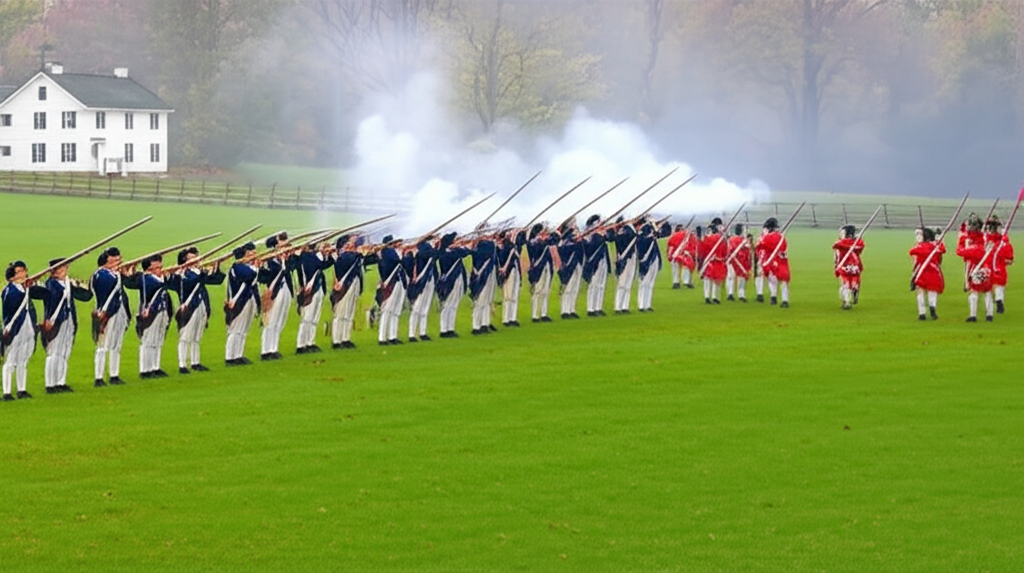
American Revolution battles in BattleGuess feature distinctive visual elements: colonial militia in civilian clothing alongside Continental Army uniforms, British redcoats in formation, and the rural American landscape of forests, rivers, and farmland. These battles appear in the American Wars era and range from easy (Bunker Hill, Yorktown) to harder (Cowpens, Monmouth). Pay attention to the style of uniforms and weapons to distinguish Revolutionary War battles from later American conflicts. You can compare American uniforms directly in the Battle encyclopedia on BattleGuess.
The Southern Campaign: The War Most Americans Forget
Textbook coverage tends to focus on the northern theatre, but the war was arguably decided in the South after 1778. British strategy pivoted to a “southern strategy” banking on loyalist support — which never materialised in the numbers expected. A grinding partisan war developed across the Carolinas and Georgia, marked by brutal small-unit fighting, switching allegiances, and extraordinary commanders on both sides.
- •Camden (1780) — a disastrous defeat that showed militia alone could not stand against British regulars in open battle
- •Kings Mountain (1780) — a loyalist force annihilated by frontier riflemen; a decisive psychological blow to British southern plans
- •Cowpens (1781) — Daniel Morgan's combined-arms masterpiece, one of the most tactically perfect American victories of the war
- •Guilford Court House (1781) — a British tactical win that cost so many casualties it forced the move north toward Yorktown
- •The partisan war led by Francis Marion, Thomas Sumter, and others tied down British resources for years
After the Shooting: Turning Victory into a Nation
Winning independence on the battlefield turned out to be the simpler part. The Continental Army had gone unpaid for years, and in the 1783 Newburgh Conspiracy officers came close to marching on Congress before Washington personally defused the crisis. The Articles of Confederation proved unable to tax or coordinate the states, prompting the 1787 Constitutional Convention. Debates over a standing army, federal power, and state militias that began in the war echo through American politics to this day. Yorktown ended one fight; the arguments it started have never fully finished.
Keep Exploring BattleGuess
The American Revolution is one chapter of a much larger independence story. These companion guides widen the lens.
- •Latin American Wars of Independence — how Bolivar and San Martin repeated the feat in the south
- •10 Most Decisive Battles in History — where Saratoga and Yorktown rank among world-history turning points
- •Battlefield Tactics Explained for Beginners — siege craft, skirmishing, and why frontal assaults failed at Bunker Hill
- •The Greatest Military Commanders of All Time — Washington, Lafayette, and the Prussian trainers of Valley Forge
- •Test your Revolution knowledge with a game mode round or browse every colonial-era battle in the encyclopedia.