The Earliest Sieges
Siege warfare is as old as fortified settlements themselves. The earliest known sieges date to the Bronze Age, when Mesopotamian and Egyptian armies developed techniques to overcome walled cities. Battering rams, scaling ladders, and earthen ramps were among the first siege tools. The Assyrian Empire became particularly adept at siege warfare, deploying sophisticated siege towers and undermining techniques that allowed them to conquer heavily fortified cities across the Near East. These early sieges could last months or even years, making logistics and supply lines just as important as military engineering.
Greek and Roman Siege Engineering
The Greeks and Romans elevated siege warfare to an engineering science. Greek inventors developed the torsion catapult, which could hurl heavy projectiles at walls from a safe distance. The Romans perfected the siege with systematic approaches: they would surround a city with circumvallation walls to prevent escape, then build ramps, deploy battering rams, and use testudo formations to protect soldiers approaching the walls. The Roman siege of Masada in 73 CE, where engineers built a massive ramp up a cliff face to reach the fortress, demonstrates the extraordinary lengths Roman armies would go to take a fortification.
- •Archimedes designed defensive machines that held off the Roman siege of Syracuse for two years
- •Roman circumvallation at Alesia involved two rings of fortifications — one facing in, one facing out
- •The testudo (tortoise) formation used interlocking shields to protect troops approaching walls
- •Roman siege engineers could undermine walls by digging tunnels and collapsing the foundations
Medieval Castles and Counter-Siege
The medieval period saw an arms race between castle builders and besiegers. Early motte-and-bailey castles gave way to massive stone fortifications with concentric walls, arrow slits, murder holes, and machicolations designed to make assault nearly impossible. Besiegers responded with trebuchets capable of hurling 300-pound stones, elaborate mining operations to collapse walls from below, and siege towers that could match the height of the tallest ramparts. Famous sieges like the Siege of Jerusalem during the First Crusade in 1099 and the prolonged English sieges of French castles during the Hundred Years’ War showcase the brutal, drawn-out nature of medieval siege warfare.
The Trebuchet: King of Medieval Siege Weapons
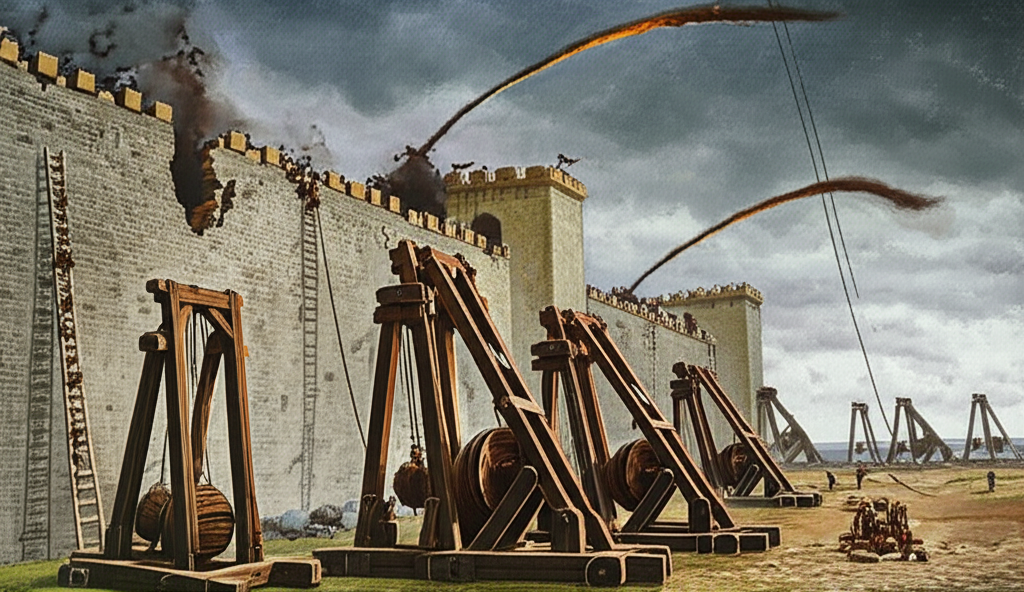
The counterweight trebuchet, developed in the 12th century, was the most powerful siege weapon of the medieval era. Unlike earlier torsion catapults, the trebuchet used a heavy counterweight to fling projectiles with devastating force and accuracy. The largest trebuchets could launch stones weighing over 100 kilograms at castle walls from several hundred meters away. Edward I of England used a massive trebuchet nicknamed "Warwolf" during the Siege of Stirling Castle) in 1304, and its destructive power was so feared that the garrison tried to surrender before it was even fully assembled.
- •Trebuchets could also launch incendiary materials, diseased animals, or even severed heads as psychological weapons
- •The counterweight design was far more reliable and powerful than earlier torsion-based catapults
- •Trebuchets required skilled engineers to construct and operate, making them expensive weapons of war
Gunpowder Changes Everything
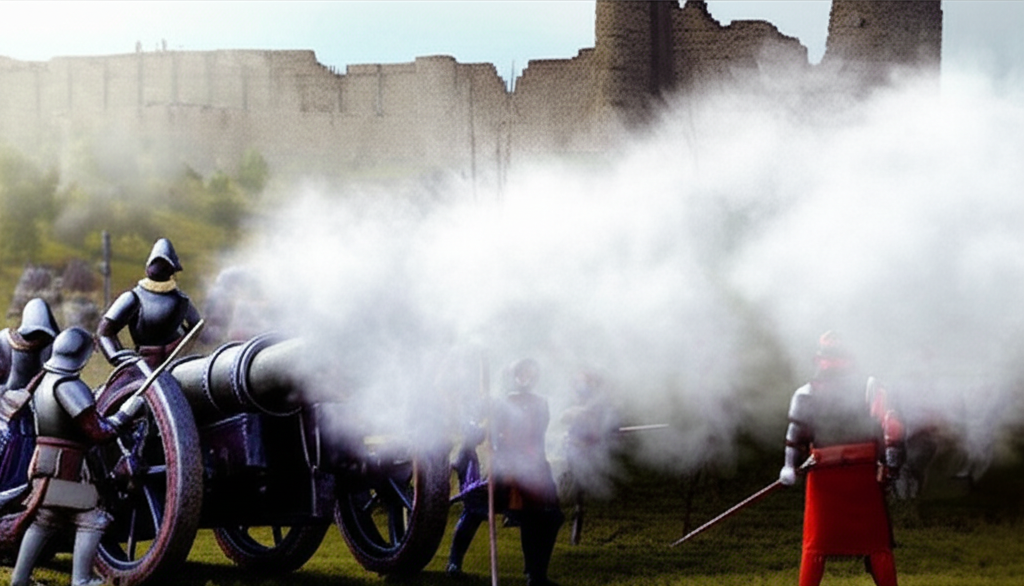
The introduction of gunpowder artillery in the 14th and 15th centuries made traditional castle walls obsolete almost overnight. The Ottoman siege of Constantinople in 1453 featured massive bombards that could shatter walls that had stood for a thousand years. European military engineers responded with the trace italienne — low, thick, angled bastions designed to deflect cannonballs and provide overlapping fields of fire. This new style of fortification, pioneered by Italian architects and perfected by Vauban in France, dominated military architecture from the 16th through the 18th centuries and shaped the layout of cities across Europe.
The shift to gunpowder also transformed who built and paid for fortifications. Medieval castles had largely been private projects of lords and bishops, but the new bastion forts demanded teams of trained engineers, huge labour forces, and constant maintenance budgets that only centralising states could sustain. Military architecture became an instrument of political consolidation: the prince who could fund a modern fortress network could tax, defend, and dominate his territory in ways a local baron could not. Vauban’s fortress belt in France is the classic example, but similar systems reshaped the Spanish Netherlands, northern Italy, and the Ottoman frontier. In this sense gunpowder did not just break walls — it redirected political power toward the kind of state that could afford to build the next generation of them.
Modern Siege Warfare
While the age of castle sieges ended, the principles of siege warfare continued to evolve. The trench warfare of World War I was essentially a continent-wide siege, with both sides attempting to break through fortified positions using artillery, gas, and eventually tanks. The Siege of Leningrad during World War II, lasting 872 days, demonstrated that siege warfare remained a devastating tactic even in the modern era. The city’s defenders endured bombardment and starvation while maintaining their resistance, making it one of the most costly sieges in human history.
The Legacy of Siege Warfare
Siege warfare shaped not just military history but architecture, urban planning, and engineering. The star-shaped fortifications of the early modern period determined the layout of cities that still exist today. Techniques developed for undermining walls led to advances in mining and tunneling. The logistics of supplying besieging armies drove innovations in transportation and supply chain management. Understanding siege warfare provides insight into how human ingenuity has been applied to both attack and defense throughout history, and many of the most famous battles in BattleGuess involve sieges that tested the limits of both attacker and defender.
Life Inside a Besieged City
For most of history, the people who suffered most in a siege were not the soldiers on either side but the civilians trapped inside the walls. Food ran out first for the poor, then the middle orders, and finally the garrison itself. Wells were poisoned, cisterns were rationed, and disease — especially dysentery and typhus — often killed more defenders than enemy action. Medieval chronicles and early modern diaries describe grim improvisations: horses eaten, leather boiled, church bells melted for shot.
Morale was managed as carefully as rations. Commanders staged religious processions, circulated rumours of relief armies, and executed anyone caught signalling to besiegers. When cities did fall, the distinction between an "honourable surrender" and a "stormed" city was not just ceremonial — it often determined whether the population was spared, ransomed, or massacred. Understanding these human realities is essential to understanding why sieges feature so heavily in the historical record: they compressed entire societies into a single prolonged crisis.
- •Rationing usually tightened first on bread, then meat, then fuel
- •Plague and dysentery often ended sieges before military action did
- •Surrender terms were negotiated documents, sometimes running to dozens of clauses
- •Stormed cities traditionally faced three days of sack under early modern laws of war
Sieges in the Nuclear and Urban Age
The end of the bastion fort did not end siege thinking — it relocated it. Twentieth- and twenty-first-century urban combat at places like Stalingrad, Hue, and more recent Middle Eastern cities has revived many classic siege problems in a new form: how to isolate a defended zone, how to manage civilian populations, and how to take fortified buildings without destroying the city around them. Modern planners still talk about cordons, breaches, and reliefs, even if the vocabulary is dressed in contemporary doctrine.
Technology has shifted the balance again. Precision munitions can replace weeks of bombardment with a single strike, while drones and persistent surveillance make the classic besieger’s job of sealing a perimeter easier than at any point in history. At the same time, dense modern cities offer defenders cover, tunnels, and media visibility that medieval garrisons could only dream of. For a broader view of how these tactics emerged, pair this post with the companion guide on How Gunpowder Changed Warfare Forever.
Keep Exploring BattleGuess
Siege warfare touches almost every era. Follow these related guides and then test yourself at BattleGuess.
- •How Gunpowder Changed Warfare Forever — the technology that made traditional castles obsolete
- •The Crusades Explained: Key Battles and Lasting Legacy — defining medieval sieges in the Holy Land
- •The Ottoman Empire’s Greatest Military Victories — the fall of Constantinople and beyond
- •The History of Cavalry: From Chariots to Tanks — the mobile counterpart to siege warfare
- •Play an era-focused round from the Game modes page or browse fortifications in the Battle encyclopedia.